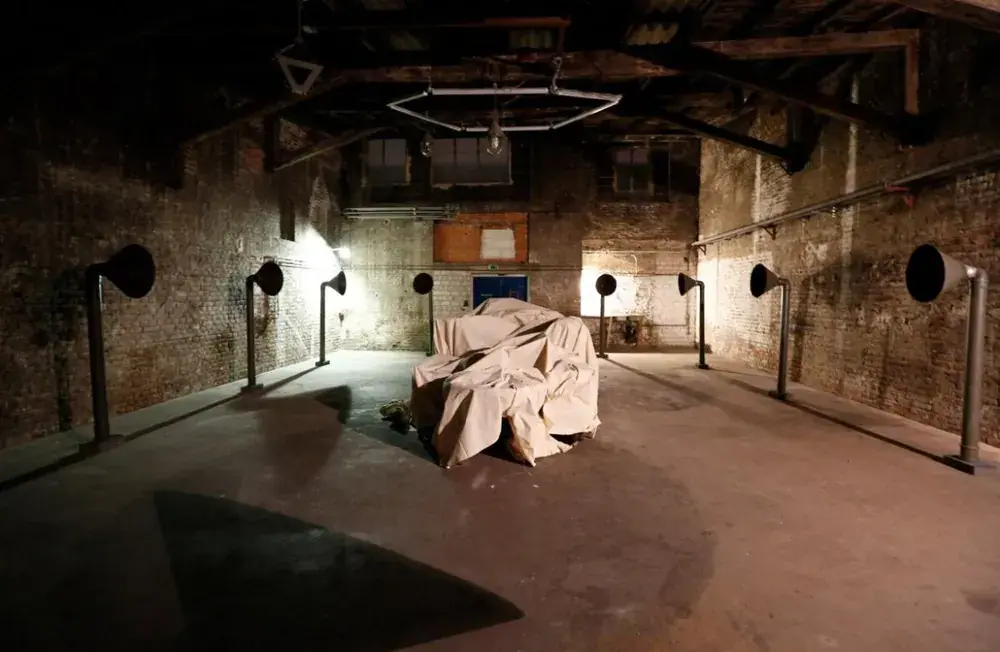
Ein Fisch der auf dem Trockenen Schwimmt
Tanzhaus West & Milchsackfabrik
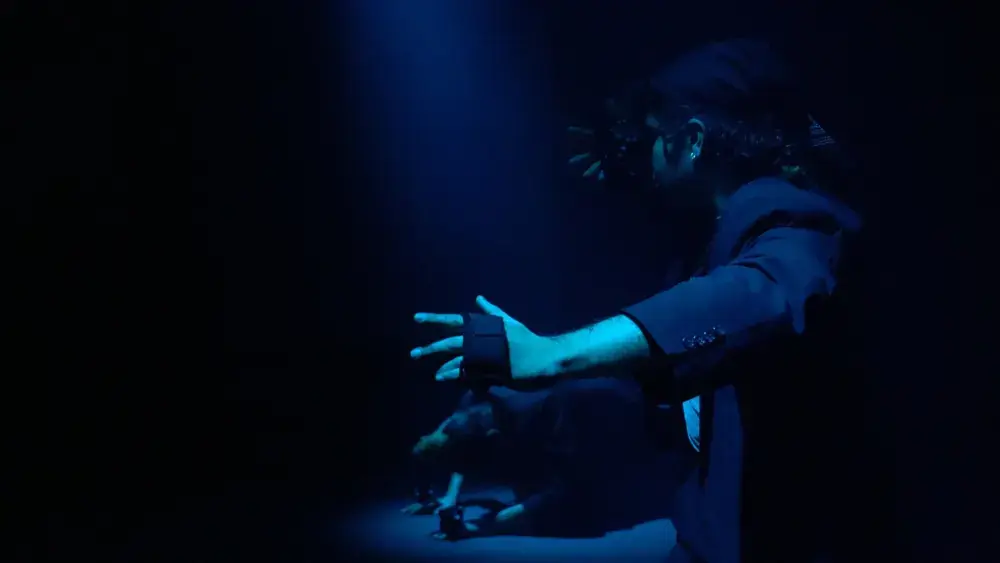
Two performers and a responsive sound system explore shared control, responsibility and non-violence through movement.

Bluzone creates a shared space between two performers and a machine. No single participant controls the outcome: movement produces sound, sound changes the next movement, and the boundary between initiating and responding begins to dissolve.

At the centre of the project is an ethical and poetic commitment to non-violence. Freedom of action carries responsibility toward the other performer and the system they inhabit together. Constraints become a condition for making something together, rather than simply a limit.
The performance asks how we communicate within boundaries, and how our actions shape the relational space we share.

Within an isolated performance space, bodily movement becomes a language of sound. Some gestures produce a response; others leave the space silent. The performers listen, adapt and develop an awareness of the system’s limits—and of one another.
The interaction resembles a digital theremin: moving through space shapes the music in real time. A hand placed on the ground can interrupt the sound, making silence part of the exchange.


The name Bluzone draws on the blue frame a projection system displays before an image appears: a moment of readiness. Here, blue becomes a metaphor for a protected space of beginning, neutrality and safety—a reduced environment in which interaction can be observed.
The first prototype was developed in late 2022 at Tanzhaus West in Frankfurt and recorded as a short video using Kinect tracking. One dancer acted within the frame while another remained outside it, for both conceptual and technical reasons. This early experiment explored the boundaries of communication and the consequences of action.
Further research developed the precision of the movement-to-sound relationship and a live performance format. The project was presented at Zimmt in Leipzig in 2025, alongside an artist and technical talk.
Strap-mounted trackers send movement coordinates to TouchDesigner, which connects to Ableton Live through Max for Live. Creative coding and node-based processing translate motion into MIDI events and sound transformations.
Vertical movement selects pitch across a 12- or 24-note range; horizontal movement controls parameters such as filter frequency or velocity. Each tracker drives a MIDI instrument, with scale constraints supporting harmonic coherence. Conditional rules determine when sound is triggered or silenced.
The modular setup can adapt to different venues while retaining the same principle: a real-time exchange between bodily movement and sonic response.
Environment: TouchDesigner
Sound: Ableton Live 11 · MOTU UltraLite-mk4
Prototype tracking: Kinect v2
Performance tracking: HTC Vive
Integration: Max for Live
Programming: Python
Prototype · Tanzhaus West, Frankfurt, late 2022
Format: video and dance
Performance · Zimmt, Leipzig, 2025
Format: dance performance, artist and technical talk
Tanzhaus West & Milchsackfabrik
With Dan Bay · Ohm

With Dan Bay · Alt Orient